User guide / Scene (physics) /
The world
Everything around the robot in a scene is its world: the ground, hills, paths, water, trees and grass, placed objects, conveyor belts, lights, the sky and the look. Robots collide with the ground, the terrain, paths and placed objects, so a car drives up a hill and a walker climbs a ramp.
Starting worlds
A new scene has two steps: Assembly, where the robot comes from (see Robots in a scene), then World, a grid of starting worlds. Simple is picked unless you choose another.
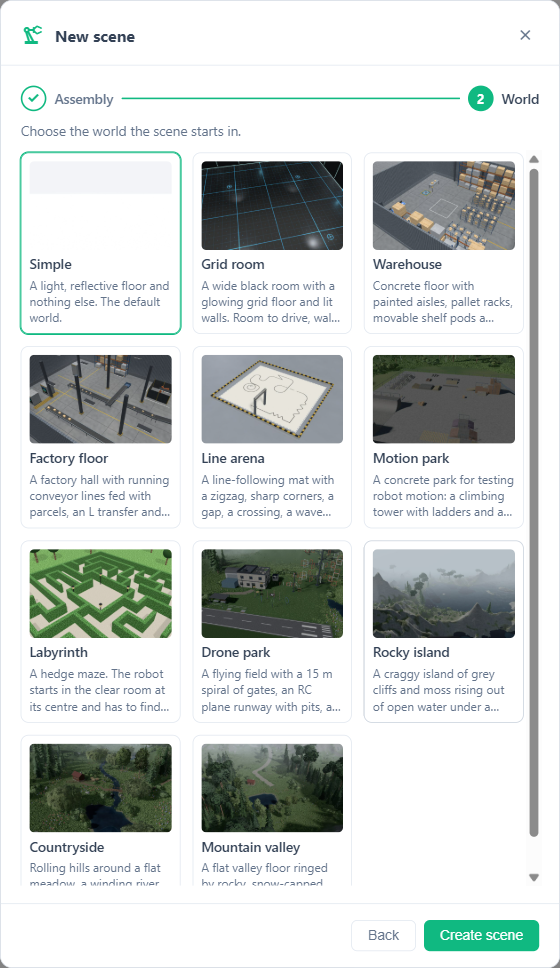
| World | What is in it |
|---|---|
| Simple | A light, reflective floor and nothing else. The default world. |
| Grid room | A wide black room with a glowing grid floor and lit walls. Room to drive, walk or fly. |
| Warehouse | Concrete floor with painted aisles, pallet racks, movable shelf pods a robot can drive under and lift, and a marked target zone by the packing bench. |
| Factory floor | A factory hall with running conveyor lines fed with parcels, an L transfer and an incline, CNC machines, a press, a fenced robot cell, racks and walkways. |
| Line arena | A line-following mat with a zigzag, sharp corners, a gap, a crossing, a wave and a spiral. The robot starts on the line. |
| Motion park | A concrete park for testing robot motion: a climbing tower with ladders and a slide, ramps from 5 to 25 degrees, stairs, a half-pipe, hurdles, stepping stones, a beam and loose crates. |
| Labyrinth | A hedge maze. The robot starts in the clear room at its centre and has to find the way out. |
| Drone park | A flying field with a 15 m spiral of gates, an RC plane runway with pits, a two-storey building of linked rooms under a half-open roof, hoops, poles, a pond and woods on rolling hills. |
| Rocky island | A craggy island of grey cliffs and moss rising out of open water under a cloudy sky. The robot starts on a floating pad. |
| Countryside | Rolling hills around a flat meadow, a winding river and a lake with a footbridge, a dirt path, woods and a cabin. |
| Mountain valley | A flat valley floor ringed by rocky, snow-capped mountains, with a lake, a pine forest and a hut. |
Every starting world keeps about 2 m clear around the centre, where the robot is placed. When the agent creates a scene it can pick a starting world too.
A starting world is only a start. Once the scene is created, its world belongs to the scene: anything in it can be moved, changed or removed, and later changes to the starting worlds don't reach scenes made from them.
Changing the world with the agent
The world is edited through the AI chat. Ask for what the scene needs in plain words:
- "Add rolling hills around the start and a dirt path the car can drive."
- "Put a pond with lilies on the left and a pine forest behind it."
- "Make the floor concrete with painted lane lines."
- "Add a conveyor belt 4 m long running at 0.4 m/s, with boxes dropping onto it every 2 seconds."
- "Move the workbench 1 m to the right."
- "Mount a spot light on the robot's front link."
The agent reads the current world first, so it can change one thing without rebuilding the rest. Objects and materials have readable names (workbench, concrete_floor), which is what makes "move the workbench" work. Every change is checked before it is saved: a missing material, a path through a field that doesn't exist or a pond off the edge of the terrain comes back as an error the agent fixes. Look at the result before relying on it; the agent can still block the robot's way or scatter more plants than needed.
The agent builds outdoor worlds from ready-made world parts, which it fits to the scene:
| Part | What it adds |
|---|---|
| Alpine ridge | Ridged peaks with granite on the steep faces and snow above three quarters of the height. |
| Country lane | A winding dirt lane graded into hills, with grassy verges and poplars along it. |
| Island coast | Rocky land rising out of open sea, cliffs on the steep shore, the coast following the land. |
| Meandering river | A river that only runs downhill, with stones on its banks, reeds and willows near the water. |
| Outdoor daylight | A sky with the sun, graded like a photograph, lit by the sky with crisp sun shadows. |
| Pine forest | Patches of pines with birches at their edges, thinning out on steep ground. |
| Pond with lilies | A pond levelled into the ground with lily pads on the water and reeds around the shore. |
| Rolling hills | Soft grassy hills with a flat start area around the origin and a ground tint by height and noise. |
| Wildflower meadow | Grass tufts and patches of yellow, purple and red flowers over a tinted lawn. |
Trees, bushes, grass, flowers, stones, logs and mushrooms come from a catalogue of ready-made 3D models. The agent can also draw a texture for a surface, such as a striped belt, a logo on a box or a floor pattern.
What a world is made of
- Ground and terrain: a floor, and an area of hills or mountains on it. Rock and snow can cover steep or high ground.
- Paths: roads and rivers. A path is graded into the ground so a robot can drive it; a river runs downhill.
- Water: a pond or lake, or open sea around an island. Water is a surface only: robots drive across the ground under it.
- Scenery: trees, grass, flowers and stones scattered over the ground. Plants such as grass are passed through; trees and rocks can be set to collide.
- Objects: boxes, cylinders, spheres and 3D models placed in the world, fixed, free to fall and be pushed, or moved by a script.
- Moving surfaces: a surface that carries what touches it, like a conveyor belt or a tank track. The belt stays in place while parcels ride it; its texture scrolls at the belt's speed.
- Launchers: spawn balls, parcels or other objects at a set rate, from a fixed spot or mounted on a robot.
- Lights, sky and look: lamps (also mountable on a robot), a sky with sun and clouds or a plain background, and the overall light and shadows.
Tips
- Large outdoor worlds with dense grass are heavy on laptop graphics. If a scene runs slowly, ask the agent to draw grass and flowers only near the camera or to thin them out.
- Trained motions are trained on a flat floor, not in the scene's world. The world is for testing them afterwards.
- Hills can't overhang. Caves, arches and ledges are placed objects.